The 10-Day Rule: 3 Steps to Fix Your Slow Month-End Close
If you’re a business owner, you know the feeling. It’s the 22nd of the month. You’re trying to decide if you can afford that new hire or if you need to pull back on your marketing spend. You check your inbox, hoping for last month’s financial reports.
Nothing.
Finally, around the 26th, your reports land. You open the PDF, take one look at the numbers, and realize they’re basically ancient history. By the time you see what happened in April, May is nearly over. You aren't navigating your business with a GPS; you're navigating it with a postcard from three weeks ago.
At Metric CFO, we call this "The Lag." And honestly? It’s a growth killer.
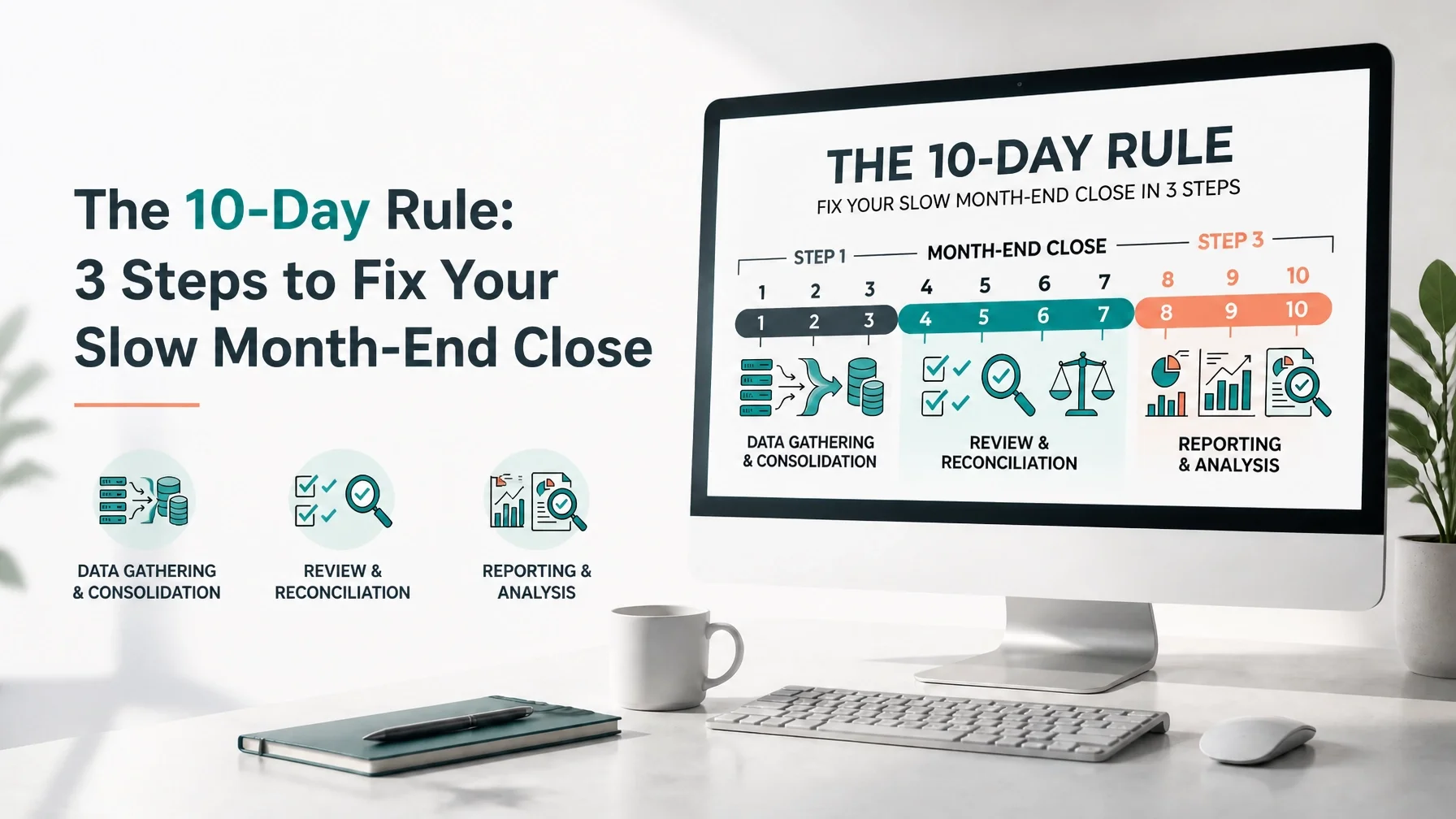
We live by the 10-Day Rule. If your month-end close is taking longer than 10 days, you aren't getting the insights you need to lead. You’re just reacting to the past. We believe that to move from "guessing" to "knowing," you need timely, accurate, and actionable monthly financial reporting.
Here is why the 10-day mark is your line in the sand: and the exact 3-step process we use to help our clients tighten that window.
Why the 10-Day Mark is the "Line in the Sand"
In the world of accounting, there’s a massive difference between "accurate" and "useful." You can have perfectly reconciled books that are 100% accurate, but if they reach you on the 28th of the following month, their utility is near zero.
Why? Because the world moves fast. If you had a massive spike in COGS (Cost of Goods Sold) in early May, but you don't find out until late June, you’ve spent six weeks bleeding margin without even knowing it.
When your close takes 20+ days, your financial data is "stale." Stale data leads to:
Hesitation: You’re afraid to make big moves because you don't know your exact cash position.
Missed Opportunities: You didn't realize you had the extra capital to invest in a limited-time deal.
Stress: That low-level hum of anxiety that comes from not being "in the loop" with your own bank account.
Getting your reports by Day 10 gives you two full weeks of the current month to make adjustments based on the previous month's performance. That’s how you scale.
Step 1: Clean Up and Automate
The biggest reason for a slow close isn't usually a "slow accountant." It’s a messy process. If your team is still manually entering receipts, chasing down missing invoices, or: heaven forbid: manually reconciling bank statements one by one, you’re never going to hit the 10-day mark.
The first thing we do is look at the "plumbing." We need to ensure that data flows into your accounting system without human intervention wherever possible.
Stop the Manual Madness
If you’re still using spreadsheets for things your accounting software should be doing, it’s time for an upgrade. We look for ways to integrate your bank feeds, payroll providers, and credit card statements directly into your ledger.
We also take a hard look at your tech stack. Are you using the right tools for your stage of growth? Sometimes, the problem is that you’ve outgrown a "basic" setup but haven't yet moved into the more robust systems that outsourced controller services can provide.
The Human vs. AI Balance
We’ve written before about AI vs human bookkeeping services, and the secret is always a blend of both. AI is great at the "doing" (the data entry), but humans are essential for the "reviewing." By automating the repetitive stuff, we free up your accounting team to focus on the actual close, rather than hunting for a missing $14.99 Netflix charge.
Step 2: The Closing Calendar (The Secret Weapon)
If you ask most business owners when their month-end close happens, they’ll say "sometime in the first two weeks." That’s not a plan; that’s a wish.
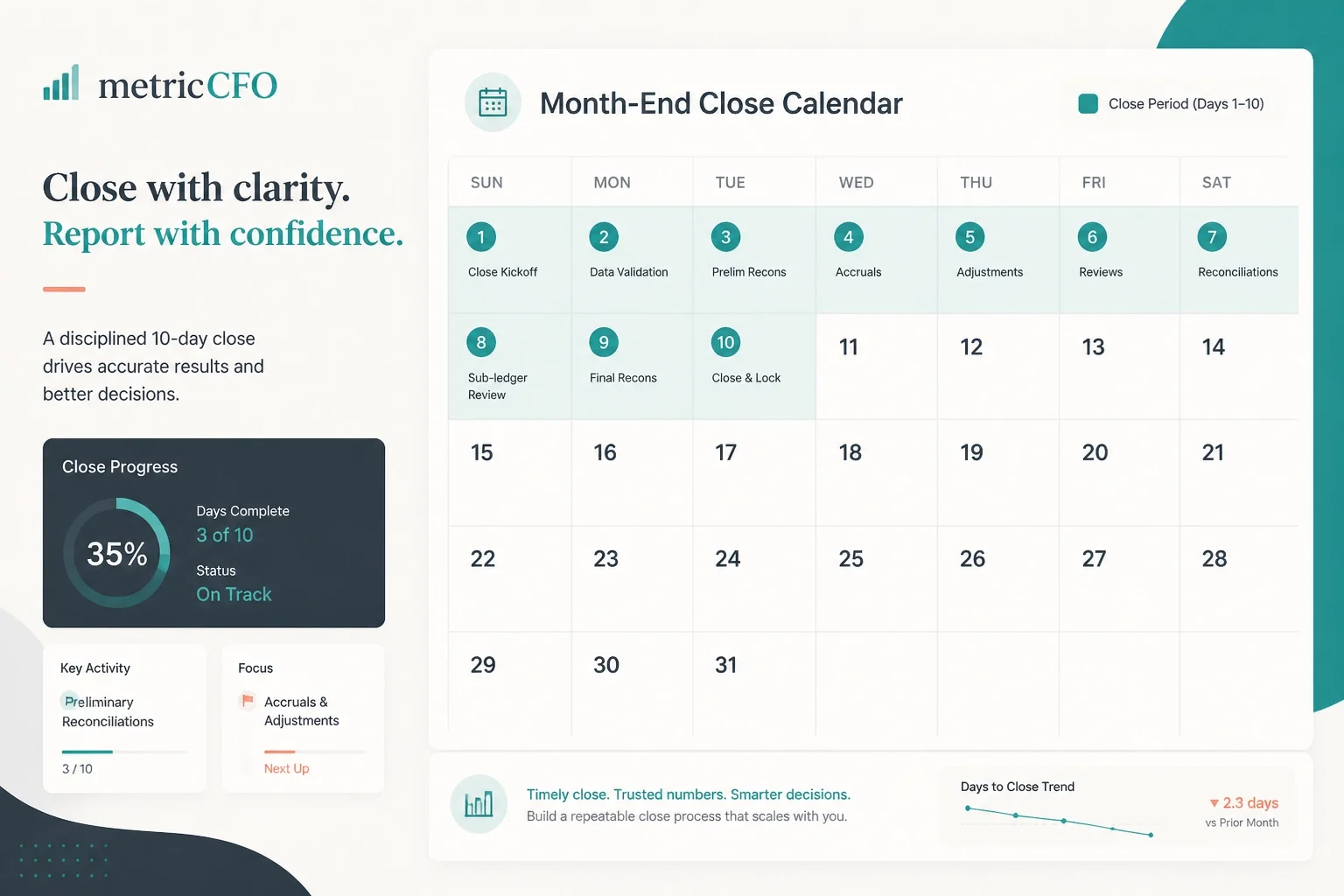
To hit a 10-day close, you need a Closing Calendar. This is a literal checklist with names, dates, and specific tasks.
Parallel Processing
Most slow closes happen because they are "sequential." Step B waits for Step A to finish. Step C waits for Step B. If Step A gets delayed, the whole house of cards falls.
Top-performing finance teams use "parallel processing." While we’re waiting for the bank statement to finalize (Step A), we can already be working on the accounts receivable review (Step B) and the payroll accruals (Step C).
A standard closing calendar looks something like this:
Day 1-2: Soft close. All transactions from the previous month are imported.
Day 3-5: Reconciliations and accruals. This is where we ensure everything matches the reality of your bank balance.
Day 6-8: Review and Adjust. We look for the "weird" stuff: unusual variances or coding errors.
Day 9-10: Reporting. The final package is prepared, checked for quality, and sent to you.

Accountability Matters
When there’s a checklist, everyone knows their role. If the AP clerk knows their deadline is Day 3 at noon, they aren't guessing. This transparency eliminates the "I'm waiting on him" excuse that plagues so many accounting departments. This level of structure is exactly what you get when you leverage fractional CFO services. We don't just "do the math"; we build the machine that makes the math happen on time.
Step 3: Shift from Data Entry to Review
The final hurdle in the 10-day rule is a mindset shift. Too many accounting teams spend 90% of their time "getting the data in" and only 10% of their time "checking what it means."
To speed things up, we flip that ratio.
By the time Day 7 rolls around, the data should be in. The final three days of the close should be dedicated to a high-level review. This is where an outsourced controller or a fractional CFO adds the most value. We aren't just making sure the columns add up; we’re looking for trends.
The "Smell Test"
Does the revenue look right compared to the pipeline? Why is the travel expense up 40% when nobody went on a trip? By shifting the focus to "Review," we catch errors faster and provide you with insights that actually matter.
If your team is exhausted just from finishing the data entry by Day 15, they’re too tired to give you a meaningful analysis. By tightening the window, we keep the momentum high so we can deliver a monthly financial reporting package that tells a story, not just a list of numbers.

From Guessing to Knowing
Let’s be honest: accounting can feel like a chore. It’s the "paperwork" of running a business. But when you treat your month-end close as a strategic priority: and you commit to the 10-Day Rule: it stops being a chore and starts being a competitive advantage.
Imagine waking up on the 10th of every month knowing exactly where you stand. You know your cash flow, you know your margins, and you know exactly how much you can invest back into your growth. That’s the "Metric CFO way."
We help businesses move from "guessing" to "knowing" by providing the structure, technology, and expertise to tighten your financial window. Whether you need a full outsourced controller service or high-level fractional CFO services, we’re here to ensure you’re looking through the windshield, not the rearview mirror.
If your close is currently taking 15, 20, or (yikes) 30 days, let’s talk. We’ve seen it all, and we know exactly how to fix it. We'll help you get those reports on time, every time, so you can get back to what you do best: building your business.
Ready to see what timely reporting feels like? Let’s connect. We can’t wait to help you take the stress out of your month-end.