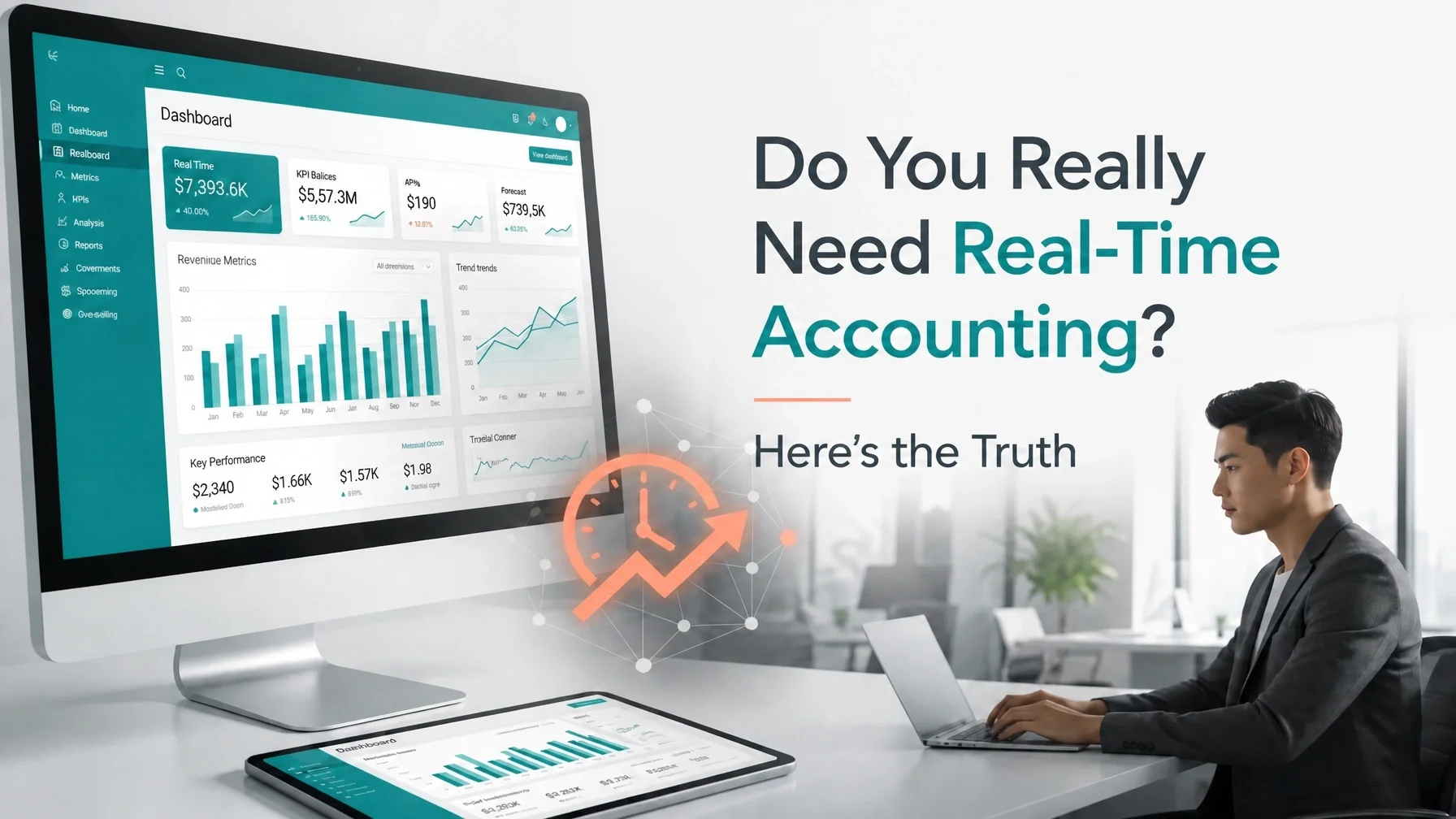
Do You Really Need Real-Time Accounting? Here’s the Truth
Hey there, Jason here.
If you’ve spent any time in the world of SaaS, fintech, or just scrolling through LinkedIn, you’ve probably seen the hype. There’s a constant drumbeat telling you that if you aren't looking at your financials in "real-time," you’re basically flying a plane with a blindfold on. The promise is tempting: a dashboard that flickers with live data, showing you every penny that moves the second it moves.
It sounds sophisticated. It sounds like the "future." But as someone who helps growing businesses navigate the messy reality of scaling, I’m here to tell you a bit of a secret:
For most of you, real-time accounting is actually just a very expensive way to get a headache.
Don't get me wrong: we love data here at Metric CFO. We live for it. But there is a massive difference between having data and having clarity. Today, we're going to pull back the curtain on the real-time accounting trend and figure out what your business actually needs to thrive without losing your mind in the process.
The Allure of the "Refresh" Button
We live in an on-demand world. We want our DoorDash tracked to the meter, our Netflix to buffer in milliseconds, and our Amazon packages to arrive before we even finish clicking "Buy Now." It’s only natural that we want our accounting to feel the same way.
The idea is that you can wake up, sip your coffee, open your laptop, and see your exact profit and loss for... yesterday. Or even better, for the last hour.
Software companies love selling this dream. They'll tell you that AI vs. human bookkeeping is the key to unlocking this instant gratification. And while tech is great, the "real-time" promise often leads to a phenomenon I like to call Financial FOMO. You start thinking that if you aren't checking your numbers every day, you’re missing some critical insight that will save your business.
In reality? Most of that "real-time" movement is just noise.
High-Frequency Noise vs. Strategic Clarity
Imagine you’re trying to lose weight. If you step on the scale every fifteen minutes, you’re going to see numbers jump up and down. You drank a glass of water? The number went up. You took off your shoes? The number went down.
Does that data help you? Not really. It just makes you anxious. It’s "real-time," but it’s meaningless because it doesn't show the trend.
Accounting is exactly the same.

When you look at your books every single day, you’re seeing the "water weight" of your business. You’re seeing a big bill that just hit, a deposit that hasn't cleared yet, or a timing difference in payroll. If you make strategic decisions based on those daily blips, you’re going to exhaust yourself and your team.
What you actually need isn't high-frequency noise; it’s strategic clarity. You need to know:
Are we more profitable this month than last month?
Is our customer acquisition cost trending in the right direction?
Do we have enough cash to make that big hire in sixty days?
You don't get those answers from a live ticker. You get them from monthly financial reporting that has been cleaned, reconciled, and analyzed by someone who knows what they’re looking at.
When Real-Time Actually Matters (The Exceptions)
Now, I’m not saying real-time data is never useful. There are specific parts of your business where speed is your best friend.
Inventory Management: If you’re selling physical products across five different channels, you need to know what’s in stock right now. Selling a product you don't have is a great way to kill your brand.
Cash-on-Hand: You should always have a pulse on your bank balance. We’re big fans of cash flow forecasting to ensure you never hit a wall.
Accounts Receivable: If a client is late on a massive payment, you want to know sooner rather than later.
But notice that these are tactical, operational needs. They aren't "accounting" in the broad sense of measuring the health and value of your company. For the big-picture stuff: the stuff that determines if your business is "deal ready": you need the perspective that only comes with a bit of time and distance.
The Cost of the "Live" Dream
Why don't we just do everything in real-time if the tech exists? Because "real-time" is incredibly expensive: and I don't just mean the software subscription.
To have truly accurate real-time books, you need a human (or a very sophisticated team) constantly categorizing, reconciling, and adjusting entries. If you rely solely on automated feeds without human oversight, your "real-time" data will be full of errors. It will show a loan payment as an "expense" or a transfer between accounts as "income."
At that point, your real-time data isn't just noisy: it’s wrong. And making decisions based on wrong data is a lot worse than making decisions based on "old" data.
This is why many founders find that fractional CFO services are a much better investment. Instead of paying for a system that spits out raw, messy data every hour, you pay for an expert who takes all that data, cleans it up once a month, and tells you exactly what it means for your future.
"Right-Time" Accounting: The Metric CFO Approach
At Metric CFO, we don't push for "real-time" for the sake of it. We push for Right-Time Accounting.
Right-time accounting means you have the information you need, exactly when you need it to make a move.
Weekly: We keep an eye on the "vital signs": cash flow, big incoming payments, and urgent bills.
Monthly: This is the deep dive. We produce a full set of financials that show you the "why" behind the numbers. This is where we catch the trends that actually matter.
Quarterly: We look at the big goals. Are we on track for the year? Do we need to pivot?
By breaking it down this way, we take the stress out of the numbers. You don't have to wonder if you should check your dashboard at 10 PM on a Tuesday. You know that your "dedicated expert" (that’s us!) is handling the heavy lifting in the background.
Moving Beyond the Bookkeeping
If you feel overwhelmed by the sheer volume of data your business generates, the answer isn't "more data, faster." The answer is usually better systems and better help.
Sometimes, a business reaches a point where standard bookkeeping isn't enough, but they aren't ready for a full-time finance department. That’s the "sweet spot" for outsourced controller services. A controller ensures the data is accurate and the processes are tight, so when the CFO looks at the reports, they’re looking at reality, not a guess.
Whether you're dealing with BOI reporting or trying to figure out your tax strategy, the goal is always the same: clarity.

The Truth About the "Live" Feed
So, do you really need real-time accounting?
The truth is, unless you are a high-frequency trading firm or a massive global logistics company, you probably don't. What you need is a reliable rhythm. You need to know that your books are being handled by professionals using high-quality outsourced accounting services.
You need to know that at the end of every month, you’ll get a report that makes sense. You want to see the path forward, not just a snapshot of where you stood five minutes ago.
Scaling a business is hard enough. Don't let the "real-time" hype add another layer of anxiety to your plate. Focus on the big moves, the strategic growth, and the things that actually move the needle. We’ll be here to handle the spreadsheets and make sure that when you do look at your numbers, they actually tell you something worth knowing.
Let's Find Your Rhythm
If you’re tired of the financial noise and want to get back to actually running your business, we’d love to help. We specialize in taking the complexity out of accounting so you can focus on what you do best.
Whether you need a hand with tax preparation or you’re looking for a fractional CFO to help you scale, we’ve got your back.
Let’s get your books to a place where they give you peace of mind, not a panic attack. Reach out to us at Metric CFO, and let’s start making your financial journey a whole lot smoother. Together, we can find the "right-time" rhythm that works for you.
Can’t wait to hear from you!
Looking for more tips on how to manage your business finances without the stress? Check out our full blog for more insights on everything from cash flow to controller services.