Starting Fresh: What Happens When a Business Has Never Had Real Books

If you’ve reached a major revenue milestone: say, your first $500k or $1M year: and your "accounting system" is still a shoebox of receipts, a messy spreadsheet, or just a prayer that the bank balance is enough to cover payroll, we have a secret for you.
You are not alone.
In fact, many of the most successful, founder-led service companies we work with start exactly like this. You were too busy building the product, landing the clients, and keeping the lights on to worry about a "Chart of Accounts." But now, the business is growing faster than your ability to track it. You need to know your margins, you need to be ready for tax season without a panic attack, and you might even be thinking about a future sale or investment.
Starting fresh can feel intimidating, but it's one of the best things you can do for your peace of mind: and your profit. Here is a look at how we take that chaos and turn it into a clear, professional financial engine.
The Difference Between a "Catch-Up" and a "Clean-Up"
When we first sit down together, we usually find ourselves doing two distinct things. While they sound similar, they solve different problems.
Catch-Up Bookkeeping is for when the work simply hasn't been done. Maybe you haven't categorized a transaction in six months, or you’ve never connected your bank accounts to an accounting tool. We go back in time, reconstruct your financial history, and bring everything up to the present day.
Clean-Up Bookkeeping is for when the work was done, but maybe not quite right. Perhaps personal expenses are mixed with business ones, or transactions were "auto-categorized" into the wrong buckets. We dig into the existing data to fix errors, reconcile balances, and make sure the numbers actually reflect reality.
Most of our new partners need a little bit of both. Whether you're looking for small business bookkeeping services to handle the daily grind or you need a deeper dive, the goal is the same: a clean slate.

The First 90 Days: Your Roadmap to Clarity
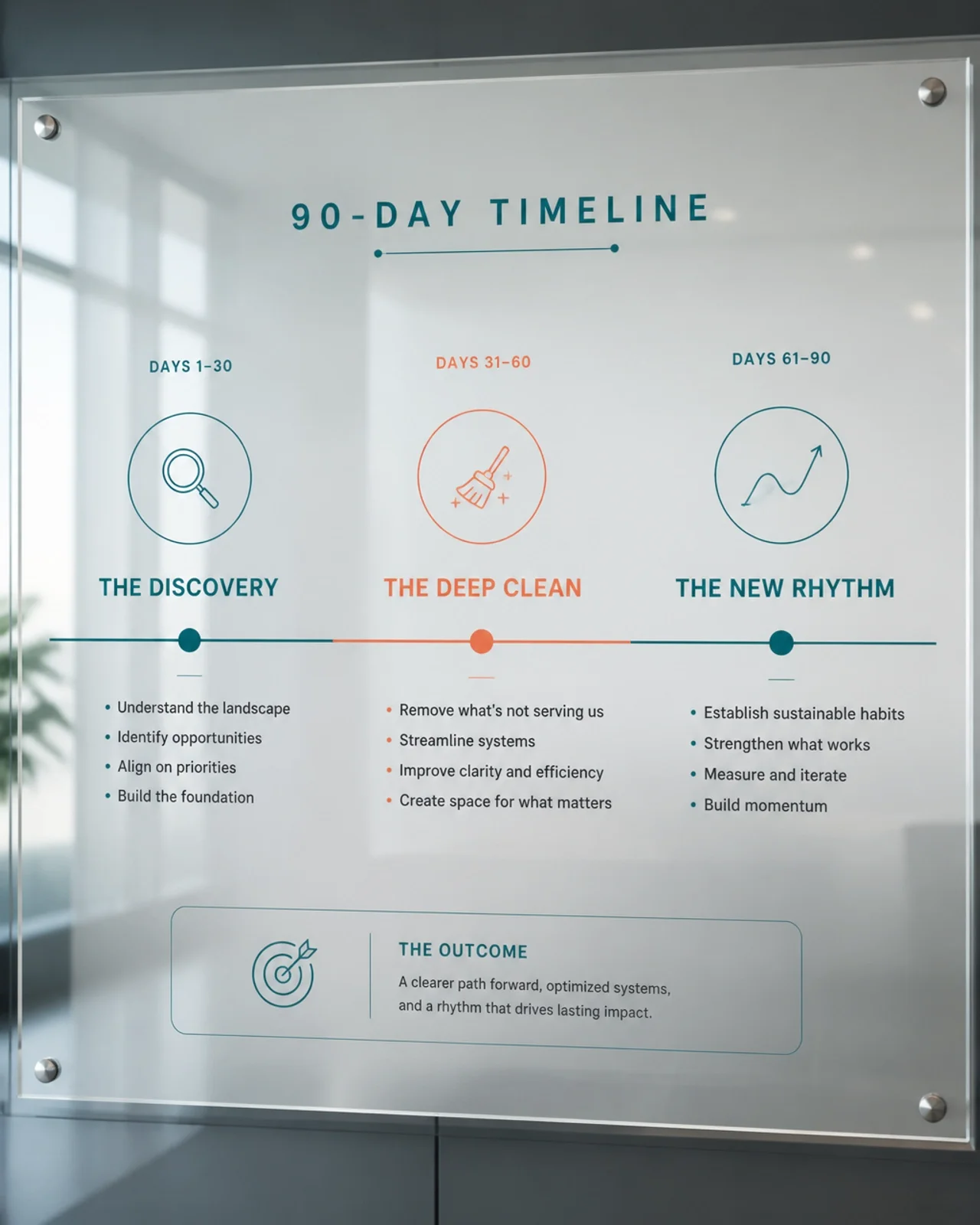
We don't just wave a magic wand and fix everything overnight (though we wish we could!). Truly professional outsourced accounting services follow a rhythm. We typically look at the first three months as a transformation period.
Month 1: The Discovery Phase
In the first 30 days, we’re the ultimate detectives. We gather access to your bank feeds, payroll systems, and payment processors like Stripe or PayPal. We’re looking for the "paper chase": statements, old tax returns, and loan documents. This is where we identify the gaps and set up your new, professional accounting environment.
Month 2: The Deep Clean
This is the heavy lifting phase. We go through every single transaction for the period we’re catching up on. We reconcile every bank and credit card account to make sure the books match your bank statements exactly. We separate business from personal (no judgment, we’ve seen it all!) and classify every dollar so you can finally see where your money is going.
Month 3: The New Rhythm
By now, the past is handled. In the third month, we start looking forward. We deliver your first set of clean monthly financial reporting. We’ll sit down together and walk through your Profit & Loss and Balance Sheet. This is the moment where the stress usually starts to melt away because you finally have a dashboard for your business.
What You Actually Get (Besides Less Stress)
By the end of this "Starting Fresh" engagement, your business looks completely different on paper. You’ll have:
Tax-Ready Books: No more rushing to find receipts in April. Your tax preparation becomes a breeze because the numbers are already verified.
Clear Margins: You’ll finally know if that big project was actually profitable or if it just felt like it was.
A Foundation for Growth: If you want to get a loan or attract an investor, the first thing they’ll ask for is a clean set of books. You’ll be ready to hand them over with confidence.
Determining Your Future: What Support Do You Need?
Once the "mess" is cleaned up, the next question is: How do we keep it this way?
As your business scales, your needs will change. It’s helpful to think of financial support in three tiers, and we can help you figure out which one fits you right now:
The Accountant/Bookkeeper: This is your foundation. They handle the day-to-day: tracking expenses, managing payroll, and keeping the books current. This is perfect for businesses that need a solid base of small business bookkeeping services.
The Controller: Think of the Controller as your financial "architect." They manage the month-end close and provide outsourced controller services that include budget tracking and KPI dashboards. They ensure your operations are scaling smoothly.
The CFO: This is your strategic partner. A fractional CFO focuses on the future: cash flow forecasting, pricing strategy, and long-term planning. They help you navigate the big decisions.

Let’s Take the First Step Together
It’s never too late to start fresh. Whether you’re six months behind or six years behind, the best time to get organized is today. We specialize in taking the weight of "messy books" off your shoulders so you can get back to the work you actually love doing.
We’re here to be your guide through the financial world, making it smooth, transparent, and: dare we say: easy. We can’t wait to hear from you and help you see just how much potential your business really has when the numbers are clear!